Measured evidenceAtlantic basin / Southeast Florida · June 2026
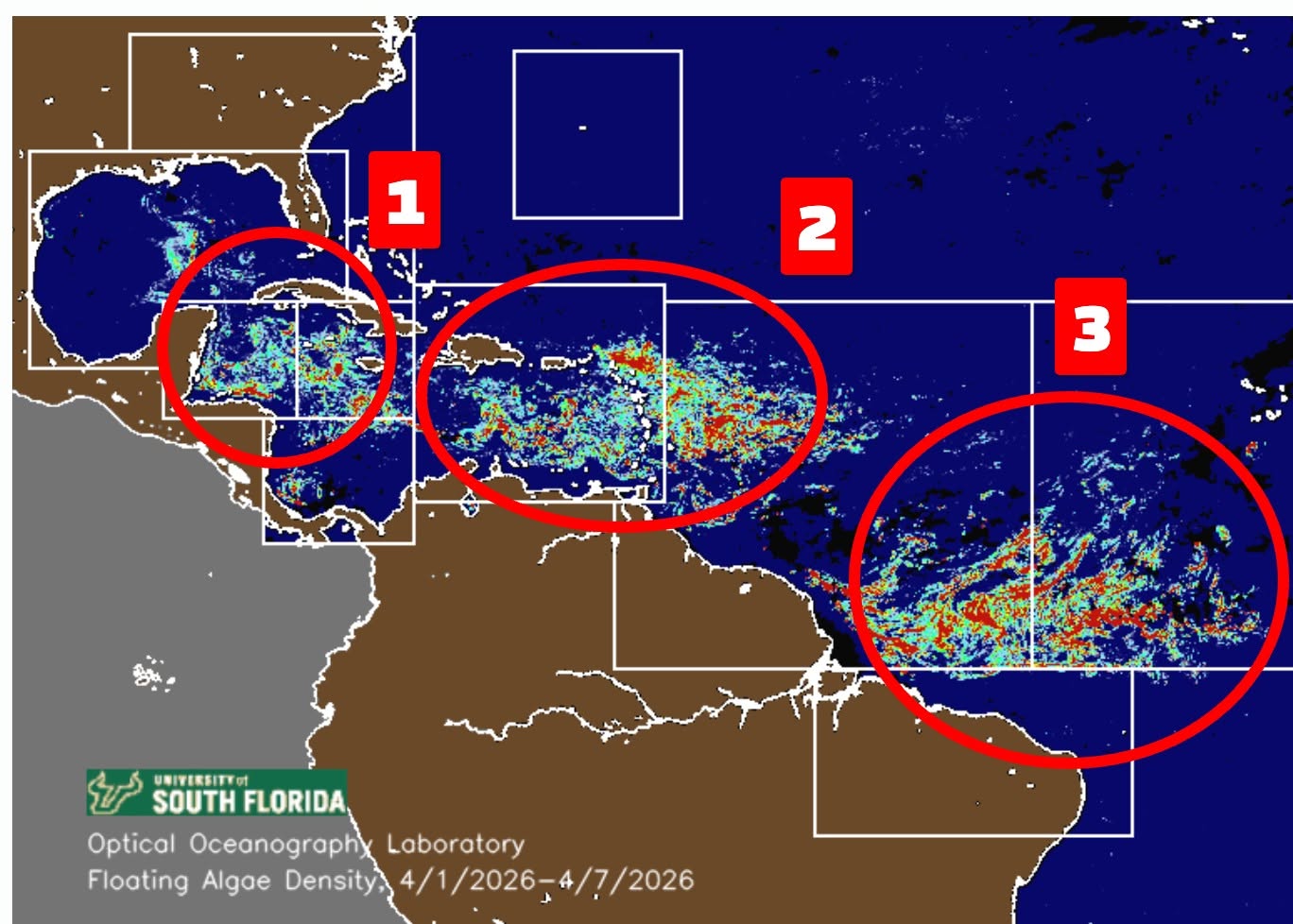
USF's satellite record documented severe southeast Florida beaching during the 2026 season, with the Great Atlantic Sargassum Belt at extraordinary abundance.
[S01] University of South Florida Optical Oceanography Laboratory
Official recordU.S. South Atlantic · 2003-2012 rulemaking, still in force
Pelagic Sargassum harvest is prohibited in South Atlantic federal waters south of the North Carolina-South Carolina boundary; north of it, harvest is tightly limited by area, season, observer, gear and annual-weight restrictions.
[S02] NOAA Fisheries[S05] NOAA Fisheries[S06] NOAA Fisheries
Measured evidenceBig Pine Key, Florida Keys · FIU monitoring report
After canal removal at Big Pine Key Canal 266, organic content fell from 31.9% to 1.0% and average sediment depth from 154 cm to 40 cm; conditions later moved back toward baseline.
[S08] Florida International University
Measured evidenceSouth Florida · 2025-2026
Decomposing Sargassum emits measurable sulfur compounds, and stranding studies document arsenic mobilization and enterococci in beach wrack.
[S12] University of Miami[S13] University of Miami / FIU[S14] Environmental Monitoring and Assessment[S15] Exposure and Health
Measured evidenceMexican Caribbean; Puerto Rico · Peer-reviewed field studies
Brown-tide events have caused severe documented seagrass and marine-animal impacts in the Mexican Caribbean and in Jobos Bay, Puerto Rico.
[S16] van Tussenbroek et al.[S17] Black et al.
Measured evidenceFlorida Keys · 2025
A Mote Marine Laboratory experiment using healthy living Sargassum collected one to five miles offshore found mixed coral responses and no final growth difference. It did not reproduce a decomposing, oxygen-depleted brown tide.
[S18] Mote Marine Laboratory / Frontiers in Marine Science
Measured evidenceU.S. Caribbean and Florida · NCCOS analysis
NOAA NCCOS modeling quantifies multimillion-dollar economic impacts to Puerto Rico, the U.S. Virgin Islands and coastal Florida.
[S19] NOAA NCCOS
Official recordNorth Miami Beach, Florida · DOH evaluation
The Florida Department of Health evaluated North Miami Beach complaints about rotting-seaweed odor and rashes, advising respiratory-sensitive people to avoid strong odors while judging long-term open-air risk minimal.
[S11] Florida Department of Health